Community Action for Biodiversity Fellowship

Introducing the CAB Fellowship

The Community Action for Biodiversity (CAB) Fellowship is a year-long program designed for experienced graduate students and professionals dedicated to local biodiversity conservation, youth empowerment through outdoor education, and creating meaningful community action opportunities. CAB Fellows are matched with a community partner to leverage their technical expertise towards a shared goal and gain experience in the field of conservation education outside of academia. In addition to trainings in transdisciplinary science and responsible community engagement, fellows receive a $10,000 stipend. 

Image

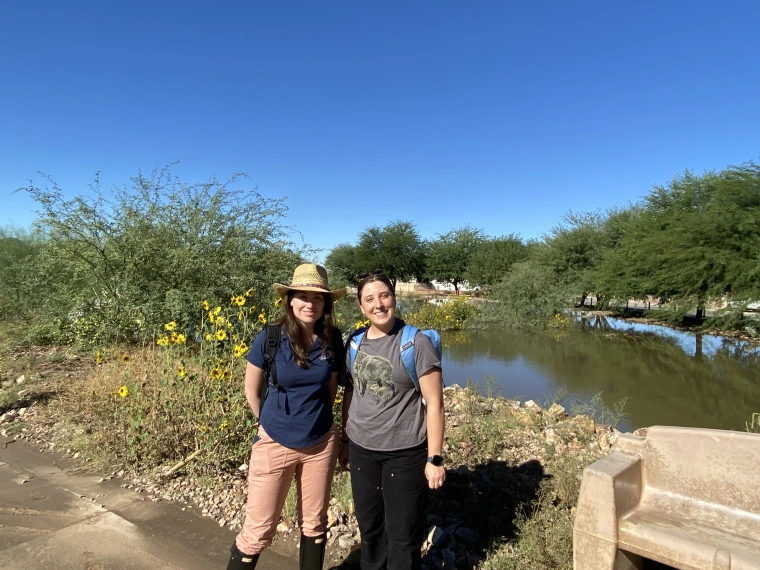
Desiree and Maddie, CAB Fellows 2025-2026, on a site visit to a stormwater park in Tucson, Arizona.

The 2025-2026 CAB Fellows are paired with community partner Ironwood Tree Experience (ITE), a local non-profit whose mission is to inspire youth to connect with their community through experiences in nature. 

The 2025-2026 CAB Fellows

The 2025-2026 CAB Fellows, Maddie Wallace and Desiree Bliss, are supporting the Water Advocates Training in Ecology, Equity and Resilience (W.A.T.E.R.) program, a partnership program between Pima County Regional Flood Control District  (PCRFCD) and Ironwood Tree Experience (ITE) designed to open up the urban landscape as a dynamic area for learning. 

Collaboratively with ITE, Maddie and Desiree are designing a new experiential learning program for high school students and teachers on biodiversity conservation, local watershed ecology, and environmental equity. The curriculum covers a range of topics from scientific thinking to monitoring and assessment. After completing this program, youth participants will be able to articulate how biodiversity and local watersheds are impacted by human development in the Sonoran Desert, express “why” biodiversity and stormwater infrastructure are valuable to them, and possess proficiency in common conservation tools and techniques. 

Desiree Bliss, postdoctoral researcher within the Arizona Institute for Resilience, says her role as a CAB Fellow “is to support curriculum development for the Water Advocates Training in Ecology, Equity and Resilience (W.A.T.E.R.) program, which involves Educator Professional Development and Field Studies for Students as well as site visits to green stormwater infrastructure (GSI) parks - the main focus of the W.A.T.E.R. program. The activities I am helping develop are called Sponge City - calculating water infiltration rates to teach about hydrology - and Mapping the Invisible - sensory mapping of sounds, smells, and touch to promote connection to place in our urban greenspaces. I am also developing an activity on mosquitoes that I am calling Buzz Patrol where students will learn how to build homemade traps, trap mosquitoes, identify mosquitoes, and how to mitigate them around their neighborhoods.”

Image
Young hand points at bunch of plants older hands hold.

Irina Flamingo

Maddie Wallace, a PhD student in the School of Natural Resources and the Environment, and the 2025-2026 Lovejoy-Carson Scholar, has long held a passion for outdoor education. Along with Desiree, she supports curriculum development for the W.A.T.E.R. program. “I am developing curriculum related to measuring and evaluating biodiversity in green stormwater parks (an urban BioBlitz), a lesson that teaches students to critically assess equity and access for community members in urban parks (Park Connections). I am also looking forward to implementing curriculum related to desert plant adaptations, seed dispersal, and pollinators.”